Showing posts with label Rudder Repair. Show all posts

Tuesday, April 2, 2013

New Rudder Tale

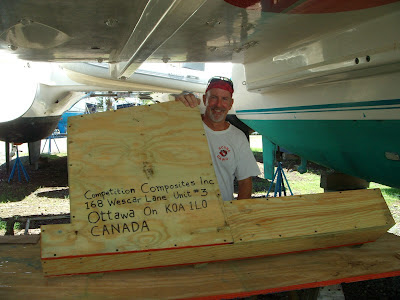
We talked about our selection process to have a new rudder built here. This post will continue with what happened after shipping off the rudder stock. Competetion Composites Inc (CCI) computer generated a pattern for the rudder based on the German Frers design drawings, machine cut the foam core, and attached it to our rudder stock.


Based on their experience, the rudder was rebuilt with unidirectional fiberglass reinforcement laid in the channel alongside the stainless post, extending down towards the tip of the rudder. This should help eliminate the "hard point" where the post ends and the rudder suddenly becomes more flexible, the area where the original fiberglass skin cracked.

The foam core was overlaid with fiberglass cloth and then sealed into plastic for vacuum infusion of the resin - basically a tube to a vacuum pump was put on one side, and a tube to the resin on the other, allowing very even clamping pressure all over the cloth, and a light, even coating of resin for the cloth.


Construction after the resin cures consists of smoothly fairing the rudder,


sanding and priming, and then CCI crated and shipped the rudder back to us. We waited until the hull was painted and the shaft cutless bearing was installed before opening the crate to inspect.


All looked well, so we removed the new lower bearing which was machined for us, and installed it into the rudder tube. The boatyard used their transporter to lift the boat, and the rudder was lifted into place. In 2008 we did this with a come-along, but the boatyard did it with six workers. I installed the ring and pin that the rudder hangs from, and then they chocked the boat back up, ready for more bottom paint!


Rough costs (US$): $5400 for the new rudder and bearing, $1500 in shipping, and $1200 for dropping the rudder, crates for the shaft outbound and rudder inbound, outbound and inbound brokerage in Grenada, Grenada ground transport.

Comparing the new rudder to the old: There is much more hydrodynamic fairing in the new foil, a flare to match the hull curve is apparent whereas this flare must have disappeared over the series of repairs I can only imagine the old rudder must have undergone. Alignment with the shaft appears better by several degress based on needing to reprogram the autopilot after carefully ensuring the rudder was aligned with the keel. We haven't noticed any difference in handling yet, but are looking forward to seeing how she responds once we get sailing.
 

Tuesday, March 12, 2013

Progress

It has been quite a while since we've blogged, so here's the scoop: After sanding out the rain damage and getting a finish coat of paint on the hull, this is what Troubadour looked like:


Next we got busy painting the Flag Blue boot stripe and priming the areas below the waterline where the bottom paint had worn through. We thought some more primer in spots wouldn't hurt, especially after grinding the rusty bottom of the keel, which was neglected until our "night in the slings" 12 hours before splash the last time we were in the yard in 2008. Hopefully by waiting the recommended amount of  time between coats (18 hours for the bottom paint!) the primer and paint will do a little better this time. We'll see!


While we were adding bottom paint, the solar panels arrived and were mounted on top of the new arch.


And after waiting for quite a while for a quiet day to apply the graphics, we finally got a quiet morning to both apply the cool new guitar graphic and reapply the name so Troubadour was no longer anonymous. The struggle to disconnect and pull the shaft (in order to replace the cutless bearing) was ultimately successful (yea!), so after the new bearing went in and the shaft was reinserted, the new rudder could be uncrated, hung and painted. Linda finished sewing the new enclosure top about the same time, and it was laced onto the frame.


We are in the process of reconnecting everything that was disconnected, restowing things that haven't been stowed for months, trying to find new homes for things that have been displaced during remodeling, and yes, disposing of things for which we haven't found a home, or have yet to find useful.

After completing the new settee cushions and enclosure top, we (Linda) still have front (dodger) and side enclosure panels to sew, two sets: one of Regalite vinyl windows and another of Phifertex mesh screens. We (Chris) keep tackling the project list while Linda sews. We (both) feel a big sense of relief having come this far and expect to be back in the water by the end of the month, if not sooner. Looking forward to floating again soon!

Monday, September 17, 2012

Rudder Rebuild


We’ve been in the boatyard for a few weeks, which is about what it takes in island time to get anything done “jus now”. It took us about a week to muddle through the options for rebuilding the rudder, which were shaping up to look like:
  1. Have the rudder rebuilt locally
  2. Ship the rudder to a knowledgeable company who would rebuild the rudder on our old stock, using the broken rudder as a pattern
  3. Have a new rudder built from the original plans

The quote from the boatyard for a local rebuild was disappointing, nearly twice as much as option two. After much emailing, Skype, and marked up digital photos, we wound up with a hybrid of two and three. One of the potential vendors, Competition Composites in Ottawa, Canada, got the original plans from German Frers Engineering (German is the designer of Troubadour, Beneteau was the builder) and gave us the option of using our original rudder post or building a new one. After a few shipping quotes, it looked like we could save a considerable amount of money instead of having a new stainless shaft built.

Prying apart the foam and fiberglass to extract the rudder post.
The boatyard set us up under a huge catamaran so we could get some shade.
Scraping the waterlogged foam from the post extension
So, with pry bars and scrapers we extracted the stainless shaft from the rudder. As it is designed to stay put, it wasn’t easy. The long shaft is welded to a plate about 2 feet square, which keeps the shaft from twisting inside the rudder. Oh, and being a solid stainless shaft welded to a four square foot stainless plate, it weighs about two hundred and fifty pounds. After extraction, to prevent damage to the bearing surfaces, we decided to have it crated which added another forty pounds to the package. Three of us got it into the back of a truck and off to Amerijet air cargo, who helpfully posts on their tracking page that it is “in transit”.


Rudder shaft in the crate


Ready to ship
In the meantime, our paint has worked its way to Grenada. By going through Sherri at Wholesale Yacht Parts and having the paint shipped here from Miami, we saved a bunch of money over the local prices for hull paint, bottom paint, and their associated thinners. In preparation for painting the hull, I decided to remove two thru-hull fittings that weren’t being used, and a third that I decided was a bad idea – to wit:

One of our bilge pumps had a large diameter hose designed to pump water overboard near the waterline. This is good, as large diameter hose has low resistance, and an outlet near the waterline means it doesn’t have to pump it uphill very far, so it makes for an efficient pump. When you live on a boat, you sleep better when you know you have a bilge pump that can pump out lots of water if necessary. You also know, or learn very quickly, that everything has a trade off. Monohull sailboats, when sailing, heel. In our case, when on a starboard tack and heeling to port, it puts the bilge pump exit underwater. That makes the exit an entrance, and water coming into the boat is bad. Since the installers weren’t insane, and did put a check valve into the line, not much water comes in, but I feel that a good portion of the water I find in the bilge after a sail is due to water backflooding from the exit hose, past the check valve, through the bilge pump, and into the bilge. I decided that eliminating water coming into the boat is preferable to a future, possible, hopefully-never-needed efficiency.

The good news is that what was probably the original thru-hull fitting is still located on the transom (back end of the boat), which doesn’t submerge when the boat heels. I can re-route the bilge pump hose there, and won’t need a check valve, which will recoup some efficiency. In the meantime, I have ground a crater into the fiberglass around each of the holes left by the fittings I removed, and am in the process of adding layer after layer of fiberglass cloth to fill the craters. This has been filling(!) my boatyard days, which have been quite short to date.

Removing our name graphic to work on a thru-hull fitting
 
While I wait for the epoxy on the fiberglass cloth to set, my motivation wanes as the sun gets high in the sky and the deck becomes too hot to walk on. Afternoons in the apartment on the top of the hill with a cool breeze are much preferable to working in the boatyard. I don’t think we’ll get all our work accomplished in the time available if I continue to work this way, but it’s nice while it lasts!

For an update to our rudder story, see this post: New Rudder Tale 
 
Fairwinds

Wednesday, August 22, 2012

Troubadour "on the rocks"

Looks can be deceiving: Troubadour is hard aground on the reef between Hartman Bay and Hog Island, Grenada.
(Rescue photos courtesy of Lilly and Tom, S/V Tiger Lilly.)
We plan to enter any anchorage by early afternoon, but this day we left Port Louis Marina an hour and a half later than planned while waiting for assistance to depart, and had to wait for our turn to fuel at Grenada Yacht Club. We were familiar with the deep channel having been on the hook at Hog Island in June. This time we chose to anchor in Hartman Bay requiring us to turn west directly into the 4 pm setting sun. Admittedly, a poor decision.
Troubadour was on the reef in seconds; Scull and crossbones marks the spot - obviously not 5 fathoms there. Harrowing reminder on chartplotter reliance.
The afternoon sun made the water look white and the red reef buoy "disappeared" from our view, even with polarized lenses. As we motored along, the chart plotter showed we were in 40 feet of water, we could see the reef to starboard, but not until we were on it did we realize our mistake.
Dinghies from nearby rushed to our aide.
Chris made a "Securite" call on VHF Channel 68 to any nearby vessels for assistance. When it was clear we weren't going to wiggle off with a few dinghies, I attempted to hail the Grenada Coast Guard. With no luck, another vessel reached me and offered to do a relay and a "Pan Pan" urgent call for assistance.

Familiar faces and new faces arrive and begin the process of kedging us off the reef.
We deployed our 80lb Manson anchor as the bow kedge, and our secondary 66lb Bruce anchor as the stern kedge, leading the aft line to the port jib winch. We also deployed two halyards for a pull to heel the boat. A diver, borrowing mask and snorkel, took a look at the situation below, stating that he felt we were wedged into a crevasse, possibly by the weight of our boat. 
Pulling on the halyards begins to heel Troubadour, while the kedges and dinghies help pull/push her to deeper water.
The only way off the reef is to heel Troubadour far onto her port side to tilt the keel above the reef. I opened all the fresh water faucets to begin to lighten our load by emptying our water tanks; three 6 gallon jerry jugs of water were secured to the end of the boom and it was eased to the port side to add even more weight for heeling.
In addition to helping hands, horsepower was critical.
The assistance of this power boat with big engines made all the difference in pulling our halyards to heel us over. Despite lots of effort, the first few attempts with dinghies resulted in them being blown downwind, where the pull didn't help.

Troubadour heels nearly to the toe rail and floats clear of the bottom.
(Notice the red buoy on the far right in this picture.)
  Once off the reef we were immediately back into 40 ft of water. Unfortunately, as we move into deeper water, damage to the rudder is evident. With on-deck help of Barb from La Luna and Stephen from Blue Pelican, we slowly entered Hartman Bay, maintaining steering control despite the damage, and anchored without incident.  Once moored, Chris and I snorkeled on the rudder and saw first hand the damage. While we lost one section of the rudder, we lashed the remainder to reinforce it. There was no damage to the keel. We stayed at anchor until we could arrange for a haul out day with calm weather at Spice Island Marine.
Troubadour awaits her turn on the "gurney" aka Travelift.
 We arranged for three extra dinghies, and extra hands on deck, for the short journey from Hartman Bay to Spice Island Marine. We made it under our own power at 3 kts in flat seas and less than 5 kts of wind. Maybe it was overkill to have so much help, but it was good to know we had capable people ready to help if the rudder fell off on the way. 
The starboard side of the rudder, showing the "chewing" damage one would expect after encountering bottom.
 
 
A chunk of the rudder cracked away as we emerged from the reef (and we thank whoever it was that brought it back for us). In car speak, the rudder is "totalled".
 Our rudder was trashed, but now it also appears that the rudder has had a number of repairs prior to us purchasing the boat, none of which were revealed by the purchase survey. Truthfully, once faired and painted, short of seller disclosure or an x-ray, I’m not sure it could have been discovered until being stressed. Basically, once the fiberglass skin cracked off, we could see lots of bondo/filler, "Great Stuff" type foam, what appears to be a missing section of shaft, and balsa core in the bottom half of the rudder. As several people have told us, perhaps it’s good it was stressed on the reef here, two miles from a boatyard, rather than in heavy seas in a storm far from land.
 
Good night Troubadour. Tomorrow's another day.
Chris and I are renting an apartment while we go through the process of repairs and research on rebuilding or buying a new rudder. Before our "visit" to the reef we were going to take care of planned maintenance and bottom painting in Trinidad in October & November at Peake Yacht Services.  But as cruisers know, all plans are in sand, and those were washed away.

Sailors say: there are those who have gone aground and those who are going to. We are grateful to all who showed up to help a stranger, and went off quietly into the sunset. Count on us to pay it forward.

A heartfelt thank you to the captains and crew of the following vessels who helped us off the reef and to the boat yard. Please let us know if we have missed anyone, it is not intentional.

Barracuda
Bella Blue
Blue Pelican
Celtic Rover

Cool Change
Elephant's Child
Impressionist
La Luna
Le Phar Blue
San Syl
Triumph
Unicorn

Yellow Shoes
Zero to Cruising


For other blog articles on our story, please check out
Zero to Cruising:
http://www.zerotocruising.com/reef-1-rudder-0/

 Elephants Child
http://sailingonelephantschild.blogspot.com/2012/08/reefs-and-junkies.html

Related Posts Plugin for WordPress, Blogger...
Sailing Blogs