Showing posts with label Passages. Show all posts

Thursday, March 5, 2020

Sailing: Grenada to Key West - Our Story


Arriving Curacao


We owe you, our readers, the story of our passage from Grenada to Key West, Florida which began October 10, 2018 with arrival in Key West on November 11. I was waiting for it to be published online (publishing rules ask that you not publish something that has been posted on a blog). It was published in the February 2020 issue of Southwinds Magazine.  


By Linda (and Chris)


   Google "Sailing the south coast of Cuba" and you will get a number of hits pertaining to "cruising Cuba's south coast" as well as a few hits for Cuba cruising guides.
   But if you wanted to sail south of Cuba to Florida without stopping you won't find many suggested guidelines, routes, or even blogs from people who've written about their experience.
Chris and I sailed the eastern Caribbean islands to Grenada in 2012. Flash forward six years and we were ready to sail home to the United States: specifically, Key West.
   The "when do we go?" was easy - after hurricane season - and a Thanksgiving family reunion became our “target” date.
   The "which way do we go?" was a little trickier. We chose to go west, because we had already sailed the eastern Caribbean. The tricky part was determining which way around that big island getting in the way of a direct route from Curacao: Cuba.
   Most people when they leave Grenada either go back north through the eastern Caribbean islands or go west to the ABC's with plans to eventually transit the Panama Canal.


Goodbye, Grenada.

The not-so common route
   Our plan was to go west to Bonaire and Curacao, make a rest stop in Jamaica, then transit through the Windward Passage around Cuba and NW to Key West.
   With downwind long distance sailing experience during a two week delivery of a new 38 foot Beneteau from Tortola to Belize in December 2017, we were confident in our route planning. Many have sailed Grenada to Bonaire, although usually beginning in Martinique to stock up on wines and delicacies, and to stay well off the coast of Venezuela and it’s out islands.
   We had no plans to go that far north for this transit (about 160 miles) so we began in Grenada and sailed 30 miles north to Union Island to stage for our passage. Forecasts called for light winds and low seas which resonated with how we planned to make our passage. Unlike our trip south to Grenada where we meandered and enjoyed the many Caribbean islands, on this trip we planned to stay in marinas long enough to rest, sight-see and re-provision (food, water, fuel), and if needed take care of repairs.

Actual route.

Weather considerations
   Some sailors might like strong winds for their trips to conserve fuel, however, Troubadour’s 120 gallon fuel capacity made this trip manageable even if we had to power or motor sail each leg. When it came to weather planning we followed our guidelines that we set eight years ago when we left Florida for the Caribbean: add 5-10 kts to every wind forecast and 3 ft to every wave forecast.  What surprised us more than anything on this trip was the remarkable accuracy of the forecasts from all our sources: Marine Weather Center (Chris Parker), NHC Offshore Waters Forecasts, Windy, Windfinder, and Garmin's inReach® which allowed us to receive marine weather forecasts directly on the device when we needed.


Friend, Tim, joins us for the first part of the passage.

Crew and watches
   Although friends were hoping to join us as crew, the realities of their lives combined with the uncertainty of sailing passage times, got in the way for many. But, friend and sailor, Tim, was able to join us for the first leg of our trip, Grenada to Bonaire.  After we said goodbye to him in Bonaire, we were on our own for the remainder of the passages.
   Night watches are easier on the crew when there are more people to share. Chris and I do best taking naps during the day if needed and having four hour shifts at night - 8 pm to midnight - Chris, midnight to 4am - Linda, and 4am to 8am-Chris.
   With an AIS transponder aboard, monitoring ship traffic day and night was easier, especially the few times when we needed to contact ships to confirm intentions or ask for course adjustments.
   While sailing downwind on a beam or broad reach is very enjoyable, it can be hard on the boat, especially in light winds as the sails luff and slap and the boom bounces and bangs even with a preventer. At times the noise concerned us enough that we chose to power and have a slightly less smooth ride instead of motor sail.

Be Ever Vigilant
   My motto from previous (especially downwind) sailing experiences is “Be Ever Vigilant” - meaning that although the passage may seem pleasant and calm as your music is playing and you’re enjoying reading a novel – something slightly sinister might be happening with your sails or rigging, below decks, or even at the bow. Therefore, just being attentive to sounds that are new or different from all other sounds of sailing, is a good practice to get into because these sounds usually mean something needs to be checked.
   As long as the weather remained calm a daily inspection of rigging, lines, shackles, tie downs, anchors, sails, stack pack, lazy jacks, reefing lines, etc. on decks, as well as dinghy tie davits and dinghy pressure to ensure the tie down straps remained tight, helped to ease any concerns about potential problems and gave us opportunities to do any repairs or adjustments before nightfall.

Our passages from Grenada to Key West (All distances are in nautical miles.)
Grenada to Bonaire
   It’s usually a day sail from Grenada to Carriacou. On Wednesday, Oct. 10, 2018, we slipped our mooring in Mount Hartman Bay, topped off diesel, gas and water at Secret Harbour Marina and opted to sail as far as Moliniere Point (8.6 nm) on Grenada’s southwest coast where we stayed for the night to enjoy snorkeling and the views of St. George’s. Leaving early the next morning we had a nice sail along Grenada’s leeward coast into Tyrell Bay, Carriacou (34 nm). We cleared customs and immigration the next morning and had gentle motor passage to Chatham Bay, Union Island (9.6 nm) where we raised the yellow flag to stage for our passage to Bonaire the next day.
   Weather was calling for light winds backing NE to SE as well as light seas, so we began reaching northwest until we could jibe over on a rhumb line for Bonaire. We arrived in three days, 443.4 miles, and averaged 6 kts in calm seas.
   We docked at Harbour Village Marina for our week-long stay in Bonaire where we rented dive tanks from Wanna Dive, an easy dinghy ride from the marina, and dined at various restaurants - our favorite being Yanni’s Arepas at Coco Beach.
   Harbour Village Marina had nice enough amenities, including onsite fuel, but we opted to wait to get fuel in Curacao, our next stop. The marina did not have on site laundry, but they did have a service that would pick up and return in two days. Again, we opted to wait understanding at the time that these services would be available at Curacao Marine. To clear in and out with customs and immigration was efficient. We walked for about ½ hour along the shore walkway with pretty views of crystal clear water, Klein Bonaire, moored boats, storefronts, homes and restaurants.

The best part of Curacao was meeting our dear friends, Patricia & Ricardo, of S/V Blues, whom we met in Grenada.
Bonaire to Curacao
   Next stop a downwind motor sail in very calm conditions to Curacao Marine - eight hours, 44.9 miles. We planned a few days at Curacao Marine to do laundry and fill water and fuel tanks. Upon arrival we learned that contrary to the advertisement in a sailing magazine, Curacao Marine did not have fuel on site. Nor, did they have on site laundry. Just as in Bonaire, the marina offered a drop off service with return in 1-2 days. A nice benefit of this marina is that they have cars to rent or will arrange a rental for you. If we would have known about the fuel we could have topped our diesel in Bonaire.  On our departure we backtracked about 6 miles to Curacao Yacht Club at Spanish Waters to top off our fuel.
   As we learned from other sailors, finding and getting to customs and immigration in Curacao is a lesson in patience, as well as good exercise. Each location is across the St. Anna Bay inlet from the other: customs in Punda and immigration in Otrabanda, thus requiring, if walking, a picturesque trek across the floating Queen Emma Bridge. Two stops, nice officials. Slow process.

Curacao to Jamaica
   To or surprise the passage to Jamaica proved to be faster than we expected at four days and 590.3 miles to Errol Flynn Marina at Port Antonio on the island’s northeast coast. We sailed on a beam to broad reach under sunny skies; average speed 6.2 kts, winds 10 – 12 kts, with 2-4 ft ocean swells. Port Antonio is located in a calm protected bay; the marina staff is helpful and friendly. We chose this location due to previous experience there and outstanding customer service. Quarantine, customs, immigration and police all came to the boat to clear us in. We were asked to remain on our boat until then. When we were ready to check out we were required to give 24-hour notice to the marina office so they could make arrangements for our clearance to leave the country.

Arriving to Port Antonio, Jamaica, after 4 days.
   Errol Flynn Marina includes laundry, tourist office, restaurant bar and pool. The town of Port Antonio is a short walk for groceries, banking, local produce, vendor markets, and fresh fish.
Fuel is at the boatyard dock nearby. While in Jamaica we toured Craighton Estate, one of the Blue Mountain coffee plantations, and indulged in a river raft cruise at the Rafter's Rest (Rio Grande Rafting).


Jamaica to Key West south of Cuba 

   Originally when looking at the forecasts we expected to beat upwind through the Windward Passage before falling off to the northwest to sail along the coast of Cuba to Key West.  Strong contrary winds and a closing weather window in Florida due to a strong northerly in the forecast forced a change in that route. We fell off immediately upon leaving Port Antonio, choosing to sail past the Cayman Islands on Cuba’s south side. The conditions for the first three days of the trip varied from light winds and seas that called for motor sailing to reaching in 8-10 of wind with lightly rolling seas.
   Once we reached Cape San Antonio, the cape which forms the western extremity of the Guanahacabibes Peninsula as well as the western extremity of Cuba, we entered the shipping lane and transited on the shoulder of the traffic separation scheme or TSS. (A Traffic Separation Scheme is an area in the sea where navigation of ships is regulated. It is meant to create lanes in the water and ships in a specific lane are all going in (roughly) the same direction.) AIS proved to be quite helpful here as we did hail a ship to query his route and intentions at night.


   After rounding the western cape we began a 36 hour beat to windward. This was the only windward sailing of our trip and we motored throughout. The winds were 14 -18 kts on the bow and the seas were made up of rolling ocean swells 3-5 feet, sometimes more. Thankfully, the seas calmed once we closed Key West, however the pounding overnight passage didn’t allow for much sleep.
   Despite those conditions we arrived at Boca Chica Marina at the Naval Air Station Key West, on the morning of Sunday, November 11 - 793.5 miles and 5 days from Jamaica. 
  Boca Chica will be our new home for the foreseeable future. 

  In total we travelled 1,924.3 miles. We spent 4 ½ weeks traveling from when we left Grenada; and, with stops, 14 days total were at sea.

Saturday, February 24, 2018

Are you still living vicariously through us?

Beach day at Grand Anse Beach, Grenada
Sailing to Belize was not on our list of places to go, but Bonaire and Curacao were and we planned to sail to both islands during November and December. But the sea washed away the sand plan and we sailed to Belize! And Tortola! And Jamaica!


Our route: A beat from Marsh Harbour to Tortola, but then a lovely run to Belize.  The trip to Jamaica was like a washing machine in the passage between Haiti and Jamaica, but the trip from Jamaica to Belize was beautiful - sunny days and starry nights.

I said I would never do a boat delivery trip - but when Chris got the call for a delivery skipper and crew from Marsh Harbour, Abaco to Tortola BVI, it sounded pretty good especially because we would be sailing on a new Leopard Catamaran. Flying to Marsh Harbour from Grenada included a stop in Miami so we took the opportunity to spend Thanksgiving with Lindy and Rich, and cousin Rose and Steve (because they just bought a house 20 minutes from  Lindy in West Palm Beach, FL.). While there Chris got a call to also deliver a new Moorings 38 from Tortola to Belize, so I agreed to be his crew again. (Better it be me than a manly man!) (On the trip to Belize we stopped for a night in Jamaica.) And that is why we didn't go to Bonaire and Curacao!


Touring the Mayan ruins in Belize.

Music and mahi, and lovely sunsets all the way to Belize. We arrived on Christmas Day and picked up a mooring in Hatchet Caye. (Yogi lavender tea helped calm my nerves during the early passage making!)

When we returned to Grenada, we still wanted to go sailing on our boat. After all she had a clean bottom from her time in the boat yard and clean bottoms are good for sailing! See our previous blog.

We slipped the mooring lines, loaded up on food, water and fuel and enjoyed sailing and vacationing in Bequia, Union Island and Carriacou.

Sugar Reef, Bequia
Captain and Linda

Scene from a walk in Bequia

Troubadour is at anchor in beautiful Bequia


Northwest side of Union Island

Roti and cold fresh (FRESH!) coconut water lunch.

Chatham Bay, Union Island


Troubadour is at anchor in Chatham Bay (one of our favorite anchorages in the Grenadines).

Sandy Island, Carriacou in the foreground; Union Island in shadow in the background. (Photo from 2013)

We are back on our mooring in Mt. Hartman Bay, Grenada. Chris is beginning his charter work and I am teaching yoga and will begin sewing projects. Of course, beach days are in my future, too. In April, we are looking forward to my sister Mary and sister-in-law, Louan coming for a visit. 

Allamanda Beach Resort on Grand Anse Beach.

Hey, I also want to give a plug to my nephew, Cody Moore. He's an aspiring hip-hop musician in Wheaton, Illinois. Here's a link to his most recent song FADEAWAY.


Thursday, March 29, 2012

Met plezier! in St. Maarten / Avoir du plaisir! Ă  Saint-Martin

What do cruisers do after an overnight voyage?
Drink a beer and take a nap!
We left the British Virgin Islands in the late afternoon on Saturday, March 10, for our overnight sail from the north sound of Virgin Gorda.  Saba Rock and the Bitter End were gorgeous places that I wished we had visited earlier. We sailed by Sir Richard Branson's Necker Island on out into the Atlantic, but not before keeping a sharp look-out for fishing traps set in long lines across our intended path for the first five miles. In this case, having the sun at our backs was a blessing because it was much easier to see and maneuver around the white floating balls. Our "rhumb line" had us on a course of 110 degrees, planning on a sunrise arrival at an estimated speed of 5-6 kts under motor sail. Troubadour rode the 8-9 ft waves gracefully (most of the time) under a moonlit sky. It really was a nice journey and all my night time sailing trepidations were lost amidst the bioluminescence in the waves, the moonrise and moonlit night. We picked up speed making our arrival an hour earlier than planned. So we had to slow down so we could arrive with enough light to drop anchor in Marigot Bay on the west side of St. Martin – the French side (where we heard customs fees were less expensive than the St. Maarten-Dutch side).

Marigot Bay, French side, St. Martin
Marigot Bay is a wide open anchorage with many fast tour boats ferrying people to the island of Anguilla. Even though it is a pretty anchorage, the boat rolled side to side quite a bit with the ferry traffic and some ocean swells. We stayed two days and while there we took the dinghy into Simpson Bay Lagoon to find places like Bobby’s Marina and Budget Marine and Island Water World, as well as to see the mega yachts. We visited the shops in Marigot and Chris ordered fresh baguettes remembering his best high school French.
  
Captain Oliver's Marina, Oyster Pond 
No explanation needed!

On Tuesday our plans were to meet with Chris's college friend Ellen and her husband, Les, for a week at Captain Oliver's Marina & Resort in Oyster Pond, directly across the island on the eastern side. We left Marigot Bay and actually sailed … for about 30 minutes … until the weather turned a bit squally and we were head to wind as we rounded the south side of the island. It was a nice journey of about three hours. We made several attempts to reach the marina before entering the marked channel into Oyster Pond, but not a soul could be raised on VHF 16 or 67 as our guide book indicated. Since we didn’t know where to find our slip, we pulled up to the fuel dock, tied ourselves off and waited for someone to show up. At 12:30 Chris went to the marina office but it was closed. He did find someone who told him that everyone was at lunch until at least 2 pm, so Chris washed down the boat and I made our lunch.

 Eventually we got our slip and had a first! It was our first time backing into a slip. This was going to be tricky because Troubadour does not like backing to starboard (right). But after only two tries we were in! Cheers to us!

Les & Ellen at the Sint Maarten Yacht Club
- searching for the New Orleans Yacht Club burgee.
Captain Oliver’s has many amenities including two restaurants, a dive shop, fresh water swimming pool and rooms overlooking the Atlantic where you can see the mountains on St. Barth’s.  The resort straddles the border of the two countries. Rumor has it that when dining in the restaurant you might be sitting on the French side while your mate could be sitting on the Dutch side!  I’m not sure what side they were on, but Les and Ellen had a nice room overlooking Oyster Pond. Before they arrived they worked out sweet deal for us to bring the boat into the marina for the week. Thanks, Les & Ellen! We'll tell you how much we really paid, later! 

Happy 50th Birthday, Ellen!
Les & Ellen rented a car and I don’t think there was a road we didn't drive down on the whole island! We had so much fun being landlubbing tourists! Our journeys took us to places like Philipsburg and Simpson Bay, Dawn Beach and Maho Bay on the Dutch side; and Orient Beach (known for its clothing optional reputation), Grand Case, and back to Marigot on the French side. The food, no wait, I mean the cuisine, is exquisite. There are so many sidewalk cafes and restaurants here, more than I have seen anywhere else in our travels. Chris and Ellen had time to catch up while we all lounged at Orient Beach; Ellen brought her guitar and they played together; and we celebrated Ellen's 50th birthday with cake and champagne aboard Troubadour.

Smoked pork ribs at the LOLO's in Grand Case
Dressing up, island style
 for dinner in Grande Case
After leaving Captain Oliver’s, we spent some time on a ball at Ilet Pinel (Pinel Island), snorkeling in the marine park and walking in the park and at the beach, reading and being very French (as in sunbathing). We spent a night in Anse Marcel, which as advertised, had fluky winds and a swell; and a few nights in Grand Case where we finally caught up on boat chores and ate a few more inexpensive meals ashore at the LOLO (locally owned/locally operated) barbeque open-air restaurants. (Inexpensive: ¼ chicken and sides, a plate of Creole shrimp, and six beers were less than we spent on two drinks each at Anse Marcel). We made the hop back to Marigot Bay to complete the circumnavigation, and await cousin Rose’s arrival on Saturday.

Sint Maarten Yacht Club

Simpson Bay Lagoon
Ilet Pinel, where we stayed a few nights

View toward Orient Beach from Ilet Pinel
Les & Ellen choose a perfect spot  for an afternoon at Orient Beach

Captain Chris and Les at the Sint Maarten Yacht Club

Les samples the locally made Guavaberry hooch!

Monday, November 21, 2011

Land fall! St. Thomas, USVI

An adventurous sail to Charlotte Amalie, St. Thomas. 

Troubadour arrived in St. Thomas, USVI, after a four hour journey from Culebra. Anticipating 5-7 foot seas and 15 - 20 kt winds we put one reef in the main. We experienced 6-foot swells with 2-3 ft wave chop - not far off of predictions. We encountered one squall with gusts to 25-30 knots relative (and seeing that coming, we reefed the jib). It was an adventurous close hauled sail; we sailed on a 16° - 20° heel, our boat speed averaged 5.5 - 6 kts, topping out at 7.8 kts, not exactly our 8.5 hull speed, but mighty feisty! What a ride!

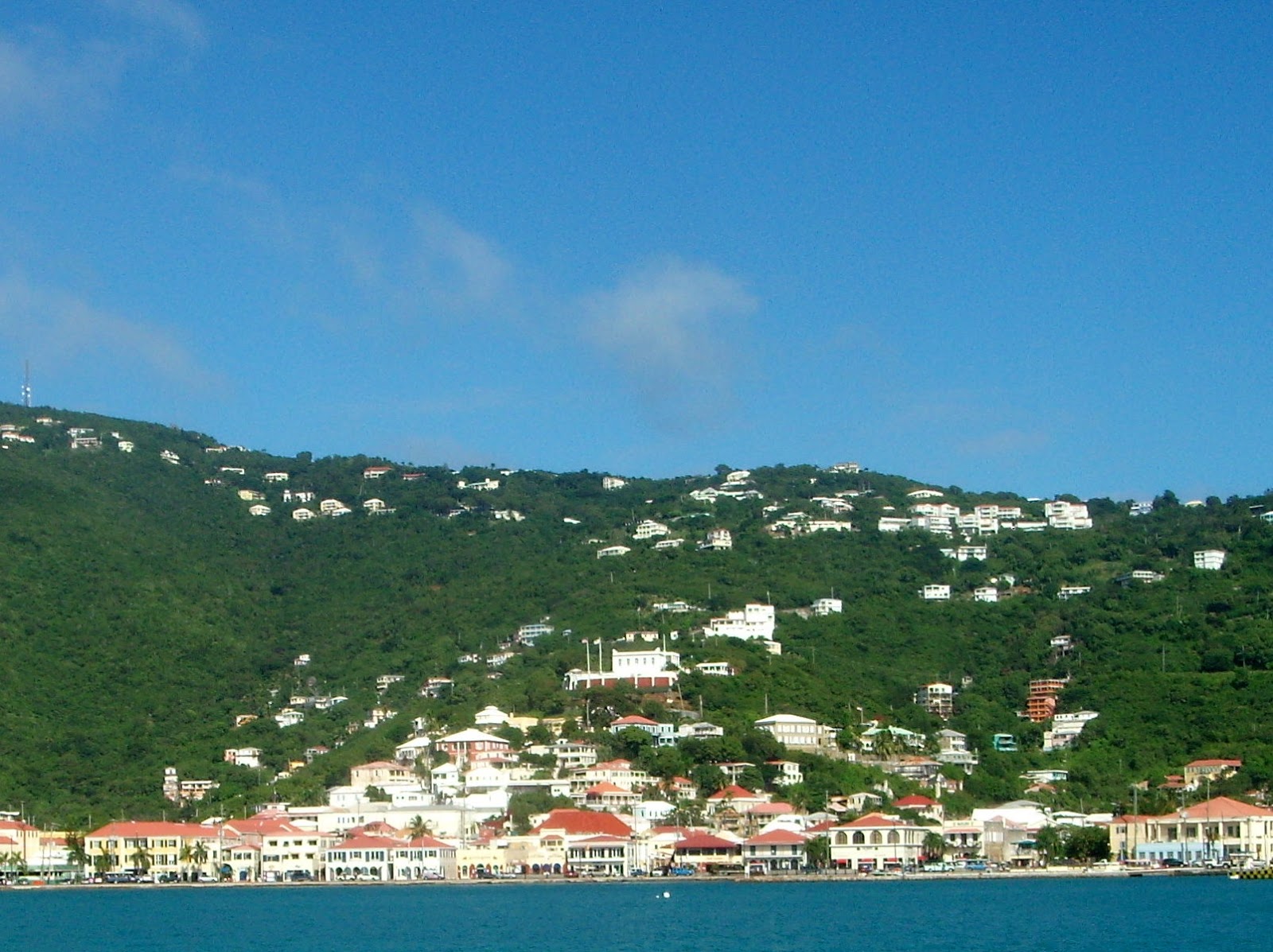
Charlotte Amalie, St. Thomas, on the horizon

We searched along Water Island for a place to anchor, but found it quite crowded for our taste. Hungry and a bit tired, we anchored for lunch at Flamingo Bay. The cruising guide was correct that the anchorage was rolly but the break gave us time to find somewhere else to anchor for the night. As the crow flies, Long Bay was two miles away so we motored south around Water Island then northeast past Hassel Island to locate a spot to anchor in 20 feet in St. Thomas Harbor at Charlotte Amalie.

Shopping area in Charlotte Amalie, as viewed from Troubadour

Charlotte Amalie from where we sit is beautiful. We poured ourselves drinks - me, a Margarita, Chris, a rum and S.O.B. Crystal Light (we are trying to come up with a name for this drink). We listened to music and danced in the cockpit in our own small celebration. As the sun set the street lights on the island lit up the hills like stars in the night sky. We feel we've reached a milestone in our travels. One year ago we were in Hatchet Bay, Eleuthera, Bahamas with our friends Skip and Lydia of Flying Pig.

A sea plane takes off in our new "backyard"
We awoke this morning to find two cruise ships in port and the sounds of commerce.  While enjoying our breakfast (of tortillas and eggs) we watched as sea planes landed and took off near Haulover Cut and tour boats ferried passengers to shore for their excursions.

The anchorage in St. Thomas Bay with cruise ship docks to the right

We marvel at how lucky we are to be in Charlotte Amalie, St. Thomas, on our own boat. And we look forward to cruising the Virgin Islands while we host family and friends aboard through February.


Fairwinds

Sunday, October 30, 2011

The Life

We said, "Why not?" 

"The literal voyage, with its pulling up of roots, is accompanied by the figurative voyage and the pulling apart of the self. Both teach you what defines you and fulfills you. If you are ready to face yourself as you are, then you will find this spiritual growth, to be vastly satisfying and energizing."
 Beth A. Leonard, "Is this the Life for You?" from The Voyager's Handbook

As of today, we have been living aboard Troubadour three years. Our journey has been filled with life lessons. Some have been tests, even ordeals, that have surprised us by strengthening us to our very core.  Others have been magical sights, sounds, and feelings that have inspired us: compassion, beauty, laughter, new bonds of friendship, the moon, the stars, the setting sun, the rain, dolphin, sea turtles, and even tears. The abundance of these gifts and many more, not only fill our souls, but they serve to encourage us to continue along this path.


"... I fish and I play my guitar
I laugh at the bar with my friends
I go home to my wife
I pray every night
I can do it all over again"
From "The Life" by Kenny Chesney

Fairwinds

Thursday, October 13, 2011

Night Passages


For many cruisers, overnight passages can’t be avoided.  It could be a necessity - because it will take you at least one night or more to arrive at your destination while under sail or motor-sailing. Or, it would be a choice – because you are faced with a sail of 10 hours or more and if you leave in the morning, there is a chance you won't make it before sunset to anchor safely with good light should you be delayed, or not sail as quickly as planned. Therefore, the option you have to consider is to leave in the evening around sunset, so that even if delayed, you will arrive in the morning with plenty of light for safe anchoring and avoiding hazards.  In any event, I think you will find sailors who love overnight passages and some who just prefer not to do them at all. 

Chris and I have done several overnight passages in our past lives - him in the Navy, both of us in yacht club distance races with six to twelve crew members. Together on Troubadour our longest passage was two nights, three days. Even with this experience, overnight passages can still be a bit scary for me. 


Lions and tigers and bears! Oh, My!

Chris, always the Navy commander, uses rational thinking to dispel my misplaced fears. He'll say, "What are you afraid of?" And I'll say something like, "the wind, the waves, the storms I can't see coming, stuff floating in the water, something breaking."

Chris will give me a perfectly logical explanation for each of my concerns, and although the fear hasn't totally seeped out of my veins, at least it's more manageable. I mean, I can't do anything
about the wind, and I have an idea on what's predicted, and it would sure be nice to sail, and I can trim the sails, and.... now, what was I afraid of? 

I guess, when I read this, it seems that the weather and sea state are my biggest concerns. So, armed with the mantra “knowledge is power,” before we pull anchor or slip the mooring we check the weather, listen to Chris Parker, and make our plans according to our comfort and our experience. This is important to consider when doing a night sail. If we followed more experienced friends out there, we might get into trouble. Therefore, we make plans based on our abilities and the capabilities of our boat. Yeah, at times, once we are out there, we might not like how it feels, but we get to expand our comfort zone for our next journey.

Safety gear


The use of safety gear on Troubadour for night sails and long passages is the same. It includes setting up the jacklines from cockpit to bow. We always have our ditch bag and EPIRB ready and near the companion way. We wear our life vests and tether ourselves to the jacklines if we have to leave the cockpit. Neither one of us leaves the cockpit unless the other is in the cockpit; and, absolutely no peeing over the side at night lest you fall in and the mate doesn’t see you. We also each have our own headlamp that sets to red light to protect our night vision (interior lights are kept off). We also talk through man overboard procedures, VHF communication, and navigation rules of the road. Knowing the rules of the road helps ease concerns about ship traffic at night. (Is that ship coming toward me or going away from me?) Chris also removes the dinghy engine and secures it either in the dinghy or in the lazarette. This is a safety maneuver to keep the dinghy engine from being caught by the seas and knocking the dinghy around on the davits. In addition, we let our family members and friends know our plans. And we regularly use our SPOT locator to indicate when we’ve arrived at a new destination. On our sail around Haiti we sent the “OK” signal from our SPOT locator every six hours.

Meals underway

Preparing for the overnight sail also includes meal planning. Truthfully, overnight meal planning on Troubadour is not all that different from day sail meal planning. I pre-make nearly all the dinner meals depending upon the number of nights we will be underway. You can't entirely predict the conditions, so having some meals ready to go is always helpful. In advance of the passages, I will usually make rice & beans, or choose simple meals such as opening a can of chili/stew to heat on the stove for dinners, making sure that my stove retainers are accessible for securing the pots. I prepare sandwiches/wraps with veggies/fruit for lunch, and breakfast is cereal or English muffins or Pop-Tarts (yes! we eat Pop-Tarts) - toasting these latter two items while the generator is running.

The overnight passage also includes pre-setting up the lee cloth in the main salon to make a comfy crib-like sleeping area; getting the headlamps accessible; having the foul weather gear in easy reach (even in the heat of the tropics it gets damp at night), and stuffing the snack bin. Snacks include baggies of popcorn (made in advance); granola and Clif Bars; peanuts; and chocolates. I boil water to pour into a thermos allowing each of us to create our own hot beverage - coffee singles for Chris, tea or hot cocoa for me. This works for us.  

Chris settles in for night passage to Royal Island, Bahamas


Night  watches and sleeping

Our night watch schedules are still being worked out. In the beginning we just took turns sleeping when we got tired. But that doesn't work well for two people who like their sleep. What has worked on our last several passages is a 3-on 3-off schedule overnight, with naps during the day if on a long passage (like our passage around Haiti). The first watch is mine, 7-10pm. While I'm on watch, Chris usually reads and snoozes because this is too early for bed for him.  I take the first watch to "shake out" those fear bugs. Chris will offer to snooze in the cockpit, if I am especially anxious. We wake each other ten minutes prior to the watch, which gives us time to wash our faces/brush our teeth, get coffee or tea and a snack. We discuss our position, the conditions and ship contacts/sightings. Then we change watch. Chris uses music as his "timer" scanning the horizon after every couple of songs on RadioMargaritaville. I like the three hour watch because it is long enough for me to stay awake and not get too nervous. During my watch I read (red-light on head lamp), watch the sea near and far every ten minutes through the binoculars for ship traffic, and check the radar every 30 minutes for ships or heavy clouds that might indicate storms. I check the sails for adjustments and watch our instruments for changes in the wind speed or direction and check our position and make course changes when we reach waypoints or as needed. Sometimes I do seated yoga stretches or just watch the bioluminescence in our wake and sing along to RadioMargaritaville. Jimmy's on night watch with me!  I guess with all this going on, who has time to be scared?
 
Although a necessity, sleeping doesn’t come that easily. There are noises that keep us awake: the whoosh of the ocean rushing by the hull, the whistling of wind in the rigging, the creaking of the floor boards or jiggling of the jib car or mainsheet shackles…and sometimes the thrum of the engine. The darkness only seems to magnify these sounds, but after a time you just sort of let them hypnotize you into a state of rest. I know I’ve slept on my off watch, but I promise you it has never been the full three hours, more like half of that time.

 Troubadour arrives at dawn at Puerta Plata,
Dominican Republic after an all night sail.
A new day dawns

Once I do get the gremlins out my mind, the beauty of the moonlit sky or the stars is mesmerizing. I search for constellations or planets, watch for falling stars and marvel at the Milky Way. Watching for the first signs of morning light on the horizon infuses me with the peace of knowing we made it through the night and we’re ok. Chris is usually at the helm at sunrise, and I awake to find we are almost near our destination. Time to put on a pot of coffee and take in the morning.

Our next night sail is likely to be from the British Virgin Islands to St. Martin sometime in early spring. I’ll listen to RadioMargaritaville, read a book, watch the stars and maybe not be so scared
this time.

Will you share what you've learned on your overnight passages, what works for you? We'd love to hear from you!

 Troubadour at rest after a 320 NM passage to Ile a Vache, Hiati.

Our experience

Here are some of our overnight passages, and some brief comments – most had beautiful sunrises and sunsets, lights glowing on island landscapes, and even dolphins playing in our bow wake.

Ponce Inlet, FL to St. Augustine, FL (shakedown cruise) - 18 hours/ 50 NM

We left on the afternoon high tide during daylight; an offshore storm overtook us bringing 35 kt wind gusts, lightning, thunder and sheets of rain. When the storm passed, conditions were flat
calm. After hours of sailing at 2 kts, we ended up motoring into St. Augustine in the late morning.

Marsh Harbor, Abaco Islands to Royal Island – 16 hours/90 NM

We wanted to arrive in the morning for best light to see in the anchorage. After leaving the Sea of Abaco through Lynard Cut, the ocean trip began with wind on the stern and following seas,
putting us ahead of our estimated arrival, and just when you get excited about that, the wind fell off, but the swells continued. Yuck. We put a preventer on the boom and motor sailed watching
the lights of Nassau in the distance.

Big Sand Cay, Turks & Caicos to Puerta Plata, DR - 15 hours/ 100 NM

Perfect.  We sailed the whole way; arrived early morning.  Chris was asked by a tug and tow to change course, and though we were under sail he agreed to fall off to pass astern of the HUGE
barge being towed. This is the rule of the road known as “the rule of gross tonnage”.

Manzanillo, DR to Ile a Vache, Haiti - 60 hours/320 NM

We sailed until we arrived in the Windward Passage where we ... lost wind, and were forced to motor between the “arms” of Haiti. After rounding the SW point, we were finally able to sail for
the last few hours into Port Morgan.

Catalina Island, DR to Ponce, PR - 28 hours/175 NM

We motor sailed into prevailing trade winds to cross the Mona Passage during the night lee. We made 7 kts when the current was with us, about 4 when against the current or big swells.

Related Posts Plugin for WordPress, Blogger...
Sailing Blogs